Home >>  INDEPENDENCE DAY
• Snippets & Interesting Info
• Gallery
• Wallpapers
• Special Articles
• Jawaharlal Nehru and the War Years
• Where the Nehrus Lived
• Of Revolts and Conspiracies
• The Satyagrahi
• Darkness at Noon
• The Brave heart
• The Educator
• The French Colony that Fought the British
• The Frontier Gandhi
• The Great Escape
• The Princess Who Led Protest Rallies
• The Mahatma's abode
• The Queen's Final Battle
• The Royal Arch
• Shaheed Bhagat Singh Biography
• Tryst with Destiny
• The Tiger of Mysore's own den
• Where the Flag was Raised
• In Birsa Munda's Kingdom
• The Nightingale of India
• Bridging the Communal Divide
• Freedom ... to be
• The Mahatma and the Masses
• The Speech That Defined A Nation
• Swaraj he said, was his Birthright
• The Iron Man of India
• Freedom FOR THE Patrotic
• The great India Truth
Kids Special
• Mother India Speaks
• 64th Independence Day


The Frontier Gandhi
The Frontier Gandhi

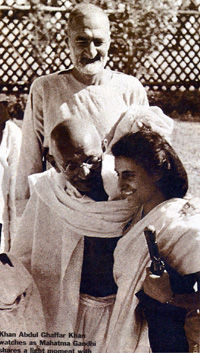
Khan Abdul Ghaffar Khan was often Mahatma Gandhi's staunchest ally during the father of the nation's civil disobedience movements. A simple man, he refused the Congress presidency a few times, opting to work as a ordinary member instead

Khan Abdul Ghaffar Khan, a devout Muslim and a lifelong pacifist, was known as Badshah Khan
(some­times written as Bacha Khan), the King of Chiefs, and Frontier Gand­hi Khan was the second son of Behram Khan, a farmer, to attend the British run Edward's Mission School This was an unusual arrangement since it was discour­aged by the local Muslims.

At school the young Khan per­formed well in his studies and his mentor, Reverend Wigram taught him the importance of education in service to the community. In his 10th and final year of high school he was offered a highly prestigious commission in The Guides, an elite corp of Pashtun and Sikh soldiers of the British Raj. However, realising that the commission were second class citizens in their country, Khan refused the offer. His wish to study further was in the process of being fulfilled when Reverend Wigram offered Khan the opportunity to follow his brother and study in London. While he eventually received the permission of his father, Khan's mother wasn't willing to lose anoth­er son to London. So Khan began working on his father's land while attempting to discern what more he might do with his life.

Unable to complete his studies, Khan began helping others. The oppression of the British, the repression of the Muslims, and an ancient culture of violence and vendetta prompted Khan to help his fellow men and women raise their standard of living by means of edu­cation. At the age of 20, Khan start­ed his first school in Utmanzai. It was an instant success and he was, soon invited into a larger circle of progressively minded reformers.

Khan had a close, spiritual, and uninhibited friendship with Mahat­ma Gandhi. The two had a deep admiration towards each other and worked together closely till 1947. The Khudai Khidmatgar - of which Khan was a senior and respected member - worked cohesively with the Indian National Congress. On several occasions when the Congress seemed to disagree with Gandhi on a policy, Ghaffar Khan remained his staunchest ally. In 1931 the Congress offered him the presidency of the party, but he refused saying, "I am a simple sol­dier and Khudai Khidmatgar, and 1 only want to serve:' He remained a member of the Congress Working Committee for a long time, resign­ing only in 1939 because of his dif­ferences with the Party's War Policy. He rejoined the Congress Party when the War Policy was revised.

Khan strongly opposed the parti­tion of India. While many Pashtuns were willing to work with Indian politicians, some Pashtuns desired independence from both the British as well as India. Targeted with being anti-Muslim, Ghaffar was attacked by fellow Muslims in 1946, leading to his hospitalisation in Peshawar.

In February 1948, Khan took the oath of allegiance to the new nation of Pakistan. Shortly afterwards he addressed the Pakistan constituent assembly and announced his sup­port for Pakistan, while at the same time his Khudai Khidmatgar move­ment pledged allegiance to Pakistan and disconnected all links to the Congress Party.