|
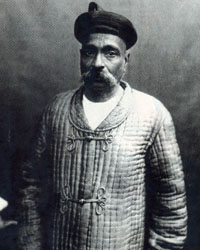
Bal Gangadhar Tilak or Lokmanya Tilak as we was fondly called, was one of the first to advocate more stringest and aggressive methods to deal with British imperialism.
Balawant Gangadhar Tilak was one of the first and strongest proponents for Swaraj (complete independence) in the Indian consciousness, and is considered the father of Hindu nationalism. Tilak's famous quote "Swaraj is my birthright, and I shall have it!" is well-remembered in India, even today. Known as the father of the Indian unrest, Tilak was the first popular leader of the Indian Independence Movement.
Born into a middle class Brahmin family, in a village near Ratnagiri in Maharashtra, Tilak was among India's first generation youth to receive a modern, college education. After graduation Tilak went on to teach mathematics in a private school in Pune and thereafter became a journalist. He strongly criticised the Western education system blaming it for demeaning the Indian students and disrespecting India's heritage. To improve the quality of education of among India's youth, Tilak organised his own education society called the Deccan Education Society.
Reverently addressed as Lokmanya (beloved of the people), Tilak was a scholar of Indian history, Sanskrit, Hinduism, Mathematics and Astronomy. He founded the Marathi daily Kesari (Lion), which fast became a popular reading for the common people of India. Tilak strongly criticized the government for its brutality in suppression 'of free expression, especially in face of protests against the division of Bengal in 1905. In the 1890s Tilak joined the Indian National Congress, but soon fell into opposition of its liberal-moderate attitude towards the fight for self-government. In 1891 he opposed the Age of Consent bill introduced after the death of a child bride from sexual injuries.
This raised the marriageable age of a child bride from 10 to 12. The C9ngress and other liberals whole-heartedly supported it but Tilak raised a battle-cry terming it as interference in Hindu Religion. Since then he was seen as a hard-core Hindu nationalist. Tilak opposed the moderate views of Gopal Krishna Gokhale, and was supported by fellow Indian nationalists Bipin Chandra Pal in Bengal and Lala Lajpat Rai in Punjab. They were referred to as the LalBal-Pal triumvirate. In 1907, at the annual session of the Congress Party, in Surat, trouble broke out and the Congress was divided between the moderates and the extremists. Till the end, Tilak remained committed to the cause of complete Swaraj. |